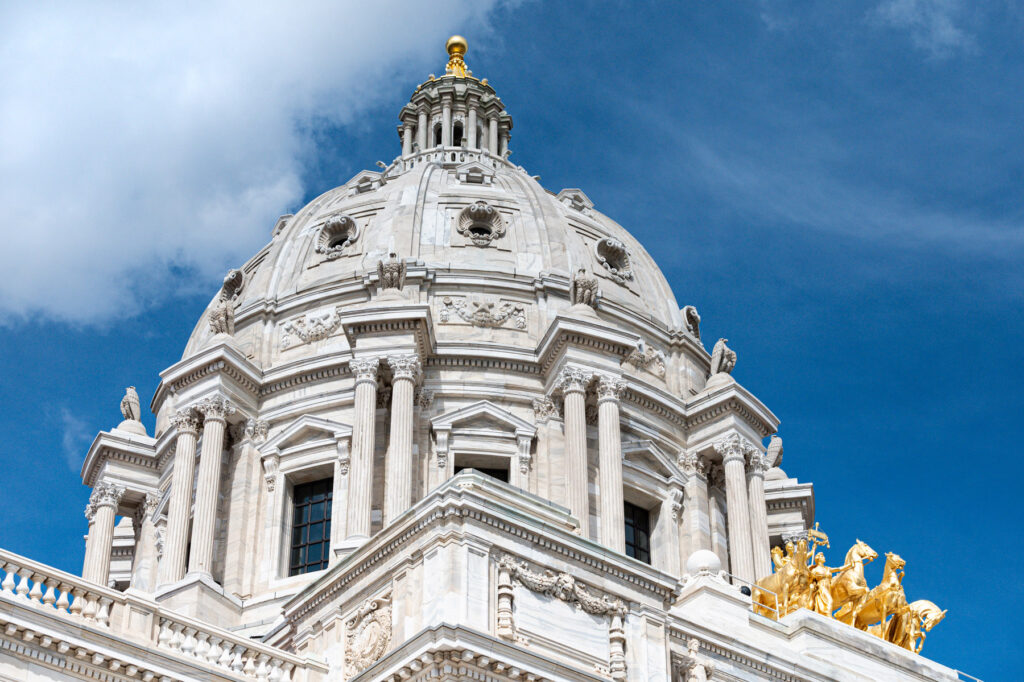
The 2026 session of the Minnesota Legislature begins at noon on February 17, 2026.
Budget Outlook: Minnesota’s Budget Forecast is Stable but Issues Remain
In December, Minnesota Management and Budget (MMB) released the first of two budget forecasts which will guide the work of the Minnesota Legislature during the 2026 legislative session. The key takeaways include:
Legislative Calendar Set; Deadlines & Recesses Announced
All four legislative leaders announced the committee deadlines for the upcoming 2026 legislative session. As with previous sessions, there are three deadlines for legislation to meet specific milestones, with the first and second falling on the same day. Please note that these deadlines do not apply to the capital investment, tax, or ways & means/finance committees.
Deadlines are as follows:
Legislative leaders also announced the schedule for legislative breaks, including:
The legislature must adjourn no later than midnight on May 18, 2026.
Numerous Special Elections Held; Political Balance Remains the Same
In 2025 Minnesota held six special elections, tying the record previously set in 1994. With unexpected deaths, resignations, and changes in elected office, six special elections took place across the state. On January 27, 2026, two additional special elections were held for seats in the Minnesota House of Representatives. In St. Paul, Democrat Meg-Luger-Nikolai defeated Republican Dan Walsh comfortably in her bid to replace former Rep. Kaohly Her who was recently sworn in as the Mayor of Saint Paul. Meanwhile, in Woodbury, Democrat Shelly Buck won an uncontested election to fill the seat vacated when Sen. Amanda Hemmingesn-Jager won her Senate seat last fall.
Power-Sharing Arrangement Continues in Evenly Split House of Representatives
The legislature will again head into the legislative session with an evenly divided House of Representatives. The committee structure is currently set up to accommodate this with co-chairs for each committee as the Republican and Democrat co-chairs will alternate committee chairs with each meeting. Like last session, this will make passing legislation more difficult, as each bill must have agreement from both sides to advance through the House of Representatives.
Retirements/Legislators Seeking Other Seats
As of today, 20 legislators have announced their retirement after the 2026 legislative session, with more expected as the session progresses. All 201 legislators are up for election in November, which means there could be significant turnover in who is representing our state. We will continue to update the public if additional announcements are made. The list of announced retirements can be found here.
Along with the growing list of retirements, 11 members of the legislature are running for other offices. Three members of the Minnesota House of Representatives, Rep. Peggy Bennett (R-Albert Lea), Rep. Lisa Demuth (R-Cold Spring), and Rep. Kristin Robbins (R-Maple Grove), are running for Governor. Members running for Congress in the 2nd district include Rep Kaela Berg (D-Burnsville), Sen. Matt Kein (D-Mendota Heights), and Sen. Eric Pratt (R-Prior Lake), and in the 7th district, Rep. Heather Keeler (D-Moorhead) is vying for the seat. Rep. Elliot Engen (R-Lino Lakes) is running for State Auditor along with Rep. Dan Wolgamott (D-Saint Cloud). Rep. Cedrick Frazier (D-New Hope) is running for Hennepin County Attorney and Maria Isa Perez-Vega (D-St. Paul) is running for Ramsey County Commissioner, District 5. The complete list can be found here.
2026 General Election
With all 201 legislative seats on the ballot, three statewide races without an incumbent, and a mounting number of retirements, the 2026 election is going to be incredibly dynamic with lots of new faces and new campaigns. On November 3, 2026 Minnesotans will go to the polls to elect a new governor, a new U.S. Senator, three constitutional officers, eight members of Congress, and a whole new state legislature. Many candidates have filed to run for governor, but that race is not the only statewide race that will be a determining factor in the political landscape of the state going forward. With all legislative races up for election this year, control of the legislature will be determined in November. The current tie in the House of Representatives will likely be resolved after the election and both parties hope to expand the extremely tight margins in the House of Representatives and Senate.
Capital Investment & Infrastructure
In January, Gov. Tim Walz introduced his $907 million capital investment proposal in advance of the 2026 legislative session. The proposal would appropriate $700 million in General Obligation or “GO” bonds, $45 million in General Fund dollars, and additional resources from the Trunk Highway Fund for a total of $907 million across all state agencies. The largest chunk of money, $316 million, would go toward preserving existing state infrastructure that are in need of maintenance. That includes $150 million for projects on Minnesota State and University of Minnesota campuses.
Additional notable projects include:
Local Tax & Related Issues Likely to be Considered
In 2023, the legislature included language in the omnibus tax bill that imposed a temporary moratorium on new local option sales taxes in an attempt to provide state leaders time to evaluate and determine how Minnesota could streamline its approval method for local sales taxes. Under current law, communities have to get special authority from the state legislature before putting the measure before voters as part of a ballot referendum. The moratorium ended in May 2025 and the legislature has not yet made substantive changes to the process for approving these taxes. Now that the moratorium is over, cities can go back to seeking new revenue for capital projects. However, some legislators are still working to pass legislation to improve the approval process for these cities. We will likely see the return of many cities and counties to the Legislature to gain approval of local sales taxes. Many cities have been turning to these taxes to build facilities and amenities for residents and to attract visitors.
Additional tax related legislation could stem from Gov. Walz’s preliminary budget proposal with discussion on a potential 0.075% sales tax cut paired with expanding the tax to professional services like accounting and legal, alongside a 6.9% increase in preliminary property tax levies, and debate on income tax adjustments. An additional debate involving tax related issues stemming from the newly implemented Paid Family Leave Program and the tax that subsequently funds it could take place. The Minnesota Department of Labor and Industry (DLI) has the authority to raise the tax of .88 percent, based on program usage, up to 1.1 percent if needed
Capitol Security Measures
In January, the Advisory Committee on Capitol Area Security met to approve a report that will be reviewed by the legislature when they convene in February. The committee engaged a third-party consultant to do a security assessment and provide recommendations on improving safety. Several of those recommendations were adopted, including improving technology and system integration across the grounds, establishing consistent post orders and staffing levels, and establishing a screening model to reduce dangerous items from entering the complex. The advisory committee also included a recommendation that weapons screening technology be added to the Capitol.
The Advisory Committee is made up of two legislators from each party, as well as Lt. Gov. Peggy Flannagan and Minnesota Supreme Court Chief Justice Natalie Hudson. The report was approved unanimously by all members of the committee, with the exception of the recommendation to allow access control and screening management. The two Republicans on the committee, Rep. Jim Nash (R-Waconia) and Sen. Warren Limmer (R-Maple Grove), voted against the recommendation.
Gov. Walz included funding for capitol security measures in this recently released bonding proposal. $41 million was included for design, construction, and equipment to increase physical security in and around the Capitol Complex.
Other Issues That May Be Addressed During the 2026 Session